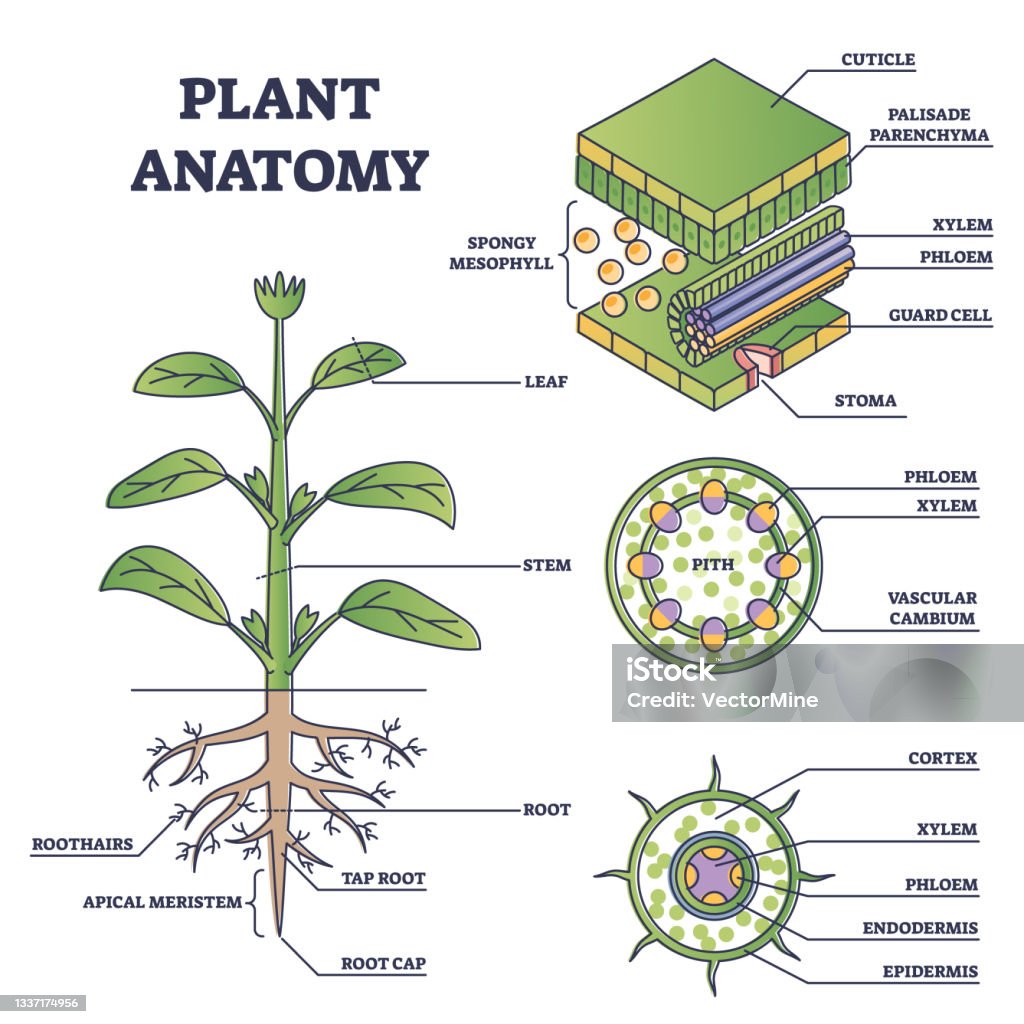
Plant Anatomy and Physiology are two closely related branches of plant science that study the structure and function of plants. Understanding both is essential in agriculture, horticulture, and plant breeding because they explain how plants grow, reproduce, and respond to their environment.
1. Plant Anatomy (Plant Structure)Definition:
Plant anatomy is the study of the internal structure and organization of plant parts — from cells to tissues and organs.
Key Components:
a) Plant Cells
-
The basic structural and functional unit of plants.
-
Contain cell walls, chloroplasts, vacuoles, and nuclei.
-
Types include parenchyma, collenchyma, and sclerenchyma.
b) Plant Tissues
-
Meristematic Tissues: Actively dividing cells responsible for growth (found in shoot tips and root tips).
-
Permanent Tissues: Mature cells specialized for specific functions.
-
Simple tissues: Parenchyma, Collenchyma, Sclerenchyma.
-
Complex tissues: Xylem (for water transport) and Phloem (for food transport).
-
c) Plant Organs
-
Roots: Anchor the plant and absorb water/minerals.
-
Stems: Support and transport nutrients between roots and leaves.
-
Leaves: Sites of photosynthesis and transpiration.
-
Flowers: Reproductive structures for producing seeds and fruits.
Definition:
Plant physiology deals with the biological functions and processes that occur within plants — how plants live, grow, and interact with their environment.
Main Processes:
a) Photosynthesis
-
Conversion of light energy into chemical energy (glucose).
-
Occurs in chloroplasts using carbon dioxide (CO₂), water (H₂O), and light energy.
-
Produces oxygen (O₂) as a by-product.
6CO2+6H2O→C6H12O6+6O26CO₂ + 6H₂O → C₆H₁₂O₆ + 6O₂6CO2+6H2O→C6H12O6+6O2
b) Respiration
-
The process by which plants break down sugars to release energy for growth and maintenance.
-
Occurs in mitochondria.
c) Transpiration
-
Loss of water vapor from aerial parts (mainly leaves) through stomata.
-
Helps in cooling, nutrient transport, and maintaining water balance.
d) Water and Mineral Uptake
-
Roots absorb water and minerals from soil through root hairs.
-
Transport occurs via xylem vessels.
e) Plant Growth and Hormones
-
Controlled by plant growth regulators (hormones) such as:
-
Auxins – cell elongation and root formation.
-
Gibberellins – stem elongation and seed germination.
-
Cytokinins – cell division.
-
Ethylene – fruit ripening.
-
Abscisic acid – stress and dormancy regulation.
-
f) Reproduction
-
Can be sexual (via flowers and seeds) or asexual (vegetative propagation).
-
Involves pollination, fertilization, seed development, and germination.
Importance of Studying Plant Anatomy and Physiology
-
Improves crop yield and productivity.
-
Enhances breeding programs for better varieties.
-
Supports pest and disease management through understanding plant defenses.
-
Guides irrigation and fertilization practices.
-
Improves post-harvest handling and storage of plant products.